Return to the Ratropolis website. Like us on Facebook.

Thursday, October 10, 2013

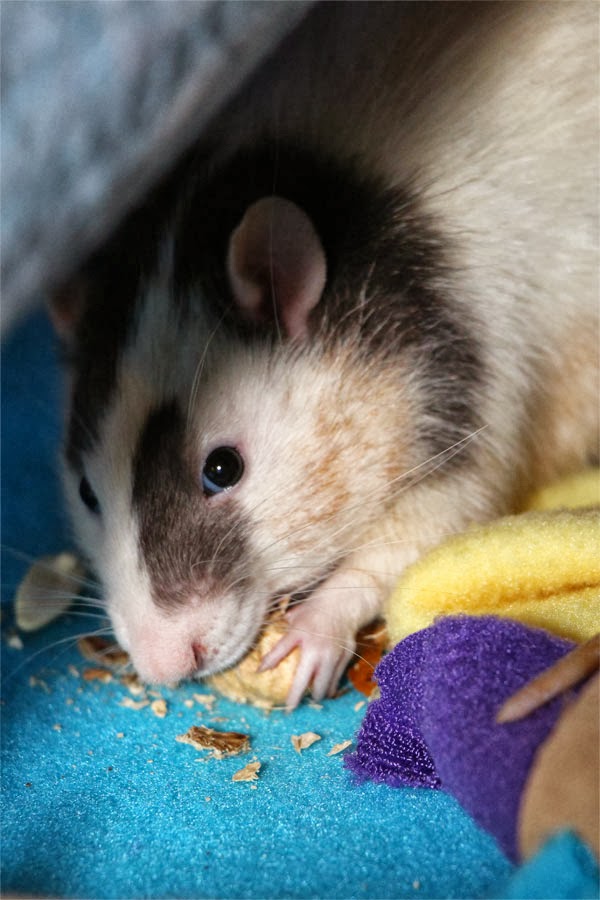
Recognizing Illness Even When the Tell-Tale Signs are Missing (Loki has a Respiratory Infection)


It seems that health problems start popping up at 1 year for me and that at around 1 1/2 years, things step up.

After recovering from an abscess and skin infection, Loki now has a URI. Ironically, he hadn't shown any respiratory symptoms except for the occasional sneeze. He did, however, suffer from a lack of appetite over the last few days. One of my litmus tests for rat health is that a healthy rat should come running to me in the morning to get to his/her breakfast. Loki stopped doing this a few days ago. He hadn't completely stopped eating - he would eventually eat the corn and a few peas - but many peas were left behind in the dish. Leaving broccoli or green beans or even carrots is not unheard of for him, but he never would leave a pea behind when he was well.

He seemed a little less active, but Loki is not a very active rat any more on a normal day. His eyes were not bright and wide like they should be; instead, they were squinty or half opened.

So in to the vet he went. Loki doesn't like the vet much. He doesn't like having his abscess drained - although he has been mighty good about it - he squeaks and cries a bit, but he doesn't bite. And unfortunately for him, the vet rechecked the abscess and found she was able to remove more pus - hopefully it will heal for good this time. He also has another small abscess developing, although it is not yet read to come to a head.

Abscess and lack of appetite aside, Loki had not shown any tell-tale signs of a respiratory infection. Yes, he would sneeze occasionally - but nothing that triggered my URI alert. There was no wheezing or congestion or porphyrin. But as soon as we got to the vet, all of Loki's defense mechanisms failed him, and his respiratory symptoms erupted. Suddenly, his breathing was loud and crackling/congested. I was quite surprised at how those symptoms just suddenly exploded out of nowhere.

Rats are prey animals and as such are great at hiding weakness and illness. Apparently, Loki had been doing double time at covering up his respiratory infection, because I hadn't noticed a thing and I am always on URI alert. At the vet, however, he reached his tipping point and the symptoms were quite obvious.

This is a good lesson for me. We need to use all of our instincts and observational powers to keep our ratties healthy. I knew something was off. He was eating, but not enough. He was even less active than usual. His eyes were not quite right. There was no one thing that screamed URI or any other specific problem, but my instincts were keyed in enough to realize that something was wrong. I think it is important for us to listen to these instincts and get them seen before the more obvious signs surface. The earlier we detect the problem, the easier it will be to treat.

This is actually a lesson I learned from keeping finches. Small birds are also prey animals and they are masters at hiding their symptoms. Finches don't bond to people, so they don't let their guard down ever when people are around and they do everything they can to look healthy until they are near death and can't do it anymore. The old saying is "A Sick Finch is a Dead Finch" and it is both true and false. Finches can be treated with proper diagnosis and medications - but you have to catch it in time. By the time a finch is obviously ill, it is nearly always too late to treat. I learned that I actually had to catch signs of illness by observing the nature of their droppings - and by looking at the droppings under a microscope - diagnosing things like yeast infections, some bacterial infections, protozoal infections, and parasitic infections before the symptoms show up. That was the only way to catch problems in time to treat them. For those who may keep birds and who are interested in learning to do this, I wrote an article on it a few years back: How to Do Your Own Fecal Smears.

Most problems that rats develop, however, are not detected via their feces. This is because they are usually not exposed to parasites via wildlife in outdoor habitats and they don't usually eat live insects, so those types of problems are less common in rats. Intestinal problems are not usually a major concern. Respiratory problems, however, are a dime a dozen. Fortunately, our rats learn to be comfortable around us and they do drop their guard when around us most of the time. We can catch problems in time to treat them. But we have to remember that sometimes we have to look at behavior and other signs that are not as obvious in order to catch problems as early as possible.

Friday, October 4, 2013

Rats and Witches?

Photo from the article. I am thinking these little ones are mice. Nice try, though.


From the Pittsburgh Post Gazette: Animal Tales: Rats Make Fine Pets, And That's Even if You Are a Real Witch

Here's a kind of cute story about a mom and her child's first rat, even though it clearly illustrates some of the mistakes first time rat owners make without actually calling those mistakes out as mistakes.

Of course, we should not get our pet rats from a pet store. Even if you close a blind eye to the mill issues, as this story illustrates, pet store employees often do not know how to sex them and it is certainly not unheard of to purchase a pregnant rat from a pet store. The narrator also didn't do enough research before agreeing to let her son get a pet rat, or she would not have purchased a single rat instead of a pair. It seems she was relying on the pet store to provide her with all of the research she needs and unfortunately, that just doesn't happen. Finally, the idea of bringing the babies back to the pet store instead of placing them herself or finding a rescue to take them in is a little sad.

So, yes, this story illustrates many of the mistakes first-time rat owners make and fails to call attention to them. Still, it is such a light-hearted take on keeping rats as pets and portrayed them in such a positive light, that I thought it was worth sharing. The little Halloween spin doesn't hurt either.

Thursday, October 3, 2013

Loki and the Girls

Loki
With Pirate having passed, I can't help but wonder how Loki would do if introduced to the girls. It is a scary thought for me, because even if we were able to introduce them, could I trust Loki not to go psycho with no warning and suddenly start attacking them - they way he did with Pirate? If things don't go well, will he start biting people again? The girls are so sweet and gentle and would never think to bite - I don't want Loki to do anything to change that and I don't want them to get hurt or to be afraid.

Our Rat-Safe Play Area (with Pirate when he was still with us)
I have brought Loki over to the girls' cage in a transport cage and he does not get all hunched and defensive like he would do with Pirate. So I started giving him play time in the girl's play pen area - a corner of our basement closed off with plywood and a large sofa. I wanted to see if the smell of the girls would trigger his bad behavior. But he was fine and seemed more interested and active then when he comes out to play in his own play area - probably because of the girls' scents.

The girls also like to come out into the play pen after Loki has been there - they clearly smell his presence and investigate everything looking for the source.

I have gone as far as putting the girls in the Martin's playpen inside the larger play area while Loki was sitting with me on the sofa. Everyone is fascinated with each other, but if Loki gets too close, Ruby and Bela squeak and run away. Jo is the problem child, though. She was the more aggressive one with Pirate - more likely to stand up to him, and it looks like she wants to take the same tact with Loki, which just won't end well. When Jo and Loki are allowed too close, they try to attack each other and that makes me afraid Loki would bite again if they were actually in close enough quarters. Then Loki starts acting all jumpy and frantic, which puts me on edge.

So I think we are going to take this process extremely slowly. The girls are fine as just a trio and Loki does fine by himself - he has seemed to prefer it, so there is no need to rush anything. I will go back to letting them get used to each other's scents in the play area, and won't try putting their cages next to each other for a while yet. It is nice, though, that at least they can share the same play area and the same toys - when Pirate was alive, Loki could not be in contact with any surface he had touched. He seems to handle the girls' scents much better than he handled Pirate's.

Monday, September 30, 2013

Cleaning and Disinfecting

I had to take a little break from the blog while getting over losing Pirate. It is always hard when one of the little guys go. Their lives are so short and yet they touch us in such a powerful way that it takes a few days to get back in the swing of things.

I have been doing a lot of fall rat cleaning over the last week or so. I am taking advantage of the nice weather before colder fall weather sets in to hose down cages and accessories outside and allow them to dry in the sunshine (sunlight is a natural disinfectant). It just seemed natural to talk about cleaning and disinfecting a little.

Cleaning is what needs to be done on a regular basis. Disinfecting is what we do when our rats' environment has been exposed to a pathogen and you need to eliminate that pathogen from the home to prevent reinfection or spread. Disinfecting can be done on a preventative basis as well, but in those cases, I usually recommend a mild disinfectant. Vinegar, for example, is a mild and natural disinfectant that has antimicrobial properties, but is safe to use around rats and other animals. I have always believed that keeping animals in a perfectly sterile environment weakens their immune systems and makes them more vulnerable if they ever are exposed to something hazardous. So I don't believe in the sterile environment philosophy. It is better for them to be exposed to things in small doses that they can easily fight off and then build up their immunities to these things.


Cages

Cleaning
To thoroughly clean our cages, I use dawn dish soap and water. To do a wipe down, I use vinegar and water. Vinegar is both a mild disinfectant that is useful for cleaning, and also is an odor neutralizer. Vinegar is especially useful for eliminating urine odor, which is essential when you keep rats.

The Martin's cage can be taken into our downstairs shower or brought outside and hosed down, but the Critter Nation needs to be cleaned in place. On rare occasions, the Critter Nation needs to be taken apart and cleaned as urine and grime can get in between the panels. I never hose down the Critter Nation because the inside of the metal frame is hollow and untreated and will quickly rust if exposed to water and not immediately dried.

If the weather is nice, allowing the cage to dry outside will also provide some preventative disinfecting - as sunshine is a natural and effective disinfectant for many pathogens.

Disinfecting
When disinfecting a cage because of a known exposure to a pathogen, it is important to know what that pathogen is susceptible to. Bleach is effective against many pathogens, is cheap, and easy to use. When using bleach, you must remove the rats to another cage and disinfect the cage in another room or outside. Bleach is less effective in the presence of organic matter, so the cage or item to be disinfected must first be cleaned to thoroughly remove any residue of urine, fecal matter, blood, mucus, hair, etc. I mix up bleach at a concentration of 10 parts water to 1 part bleach unless the literature regarding the pathogen I am trying to eliminate recommends some other concentration. If possible, keep the surfaces in contact with the bleach for 10 minutes before rinsing. Make sure to thoroughly rinse and then dry the cage before returning the rats to the cage. Bleach fumes can be extremely harsh on their lungs. Make sure the cage does not smell like bleach when you return it to use. Drying the cage in sunlight can be extra helpful.

Some pathogens, like coccidia and giardia, are less susceptible to bleach. In that case, another disinfectant may be called for. Coccidia, for example, is supposed to be susceptible to ammonia (never mix ammonia and bleach - the combination releases a toxic gas). Heat is also often used to safely disinfect when bleach is not effective. While rat cages are too large to disinfect in a dishwasher at antibacterial settings, soaking the cage parts in water that has been heated to boiling may kill off any pathogens. Exposed carriers may be able to be disinfected in the dishwasher on the antibacterial cycle.

Note that you do not have to disinfect cages because of exposure to respiratory infections caused by mycoplasma. All rats carry this bacteria, and thus we do not need to worry about spread from the environment. Rats become ill when their immune system is weakened, not from re-exposure to the mycoplasma itself.

Glass
Glass is fairly easy to clean and disinfect, so I always use glass water bottles instead of plastic ones. Because the water bottles are always exposed to water and air, they can be quick to harbor bacteria.

Cleaning
I clean glass water bottles in the dishwasher on the regular setting. I first do a quick rub down with a bottle brush, as the dishwasher may not reach inside the narrow opening as well as I would like.

Disinfecting
I disinfect glass water bottles on the antibacterial cycle of my dishwasher or by soaking in a bleach solution and then thoroughly rinsing. I like to dry in the sunlight if the weather cooperates.

Plastic
Plastic is easy to clean but actually is pretty hard to disinfect (one reason I use glass water bottles instead of plastic ones).

Cleaning
For regular cleaning of plastic, I just use Dawn dish soap and water (or wipe down with vinegar for a quick touch up).

Disinfecting
For disinfecting, I first clean the item to remove urine residue and debris, then soak in a bleach water solution for 10 minutes. Alternatively, I have a dishwasher that has an antibacterial cycle that runs at an extremely high temperature to kill most bacteria/spores/parasite eggs, etc. However, some plastics cannot handle temperatures so high and can melt or warp in that cycle - others are tougher and do fine. I have used that cycle with success to kill coccidia oocysts in a hospital cage/pan/drinkers/seed trays that held infected birds.

Wood
Wood is hard to clean and to disinfect because it is so porous.

Cleaning
I soak wood in a vinegar water solution to clean it. When it has been around for a while, I replace it.

Disinfecting
Pitch everything made of wood and replace it - wood just cannot be thoroughly disinfected and it is better to just get rid of it than risk re-exposure or spread of disease.

Lava Ledges
Lava ledges are pumice stone and are also very porous.

Cleaning
I also clean these by soaking in vinegar/water solution.

Disinfecting
I would replace these in case of a contagion as well - just because there are so many holes and crevices for bacteria to hide in. Soaking in bleach solution may be effective, but I personally would probably not risk it. Also, I don't like soaking anything in bleach that the rats like to chew on - and my rats chew the lava ledges.

Fabric
Cleaning
I wash my hammocks and liners using a dye-free and fragrance-free detergent (I use Tide Free and Gentle, but any brand would do). I wash on hot to kill any bacteria present and use vinegar in the rinse cycle, running a second rinse cycle to make sure everything rinses out thoroughly. If urine odor is a problem for you and you are not worried about pathogens, you may want to wash in cold water, as urine stains are protein stains and cold water is more effective at eliminating them. However, I have found that as long as I use vinegar in the rinse, I don't have a problem with urine odor in the hammocks and liners - even when I wash on hot - so I prefer to kill off anything that might be lurking in there by using the hot cycle.

Disinfecting.

Washing in hot water and drying on the highest heat setting will kill most things (this is effective against ringworm, for example). My machine also has a sanitary cycle (extremely hot) with a Steam option that would probably be helpful if I am ever hit with something nasty that I want to make sure I get rid of. However, if I were dealing with something that bad, I would pitch the hammocks afterwards anyway. They chew through them quickly - no sense keeping them around if there is a chance they might get reinfected with something nasty.

The good thing is that because our rats don't usually go outside where they are exposed to bird and animal droppings and they don't usually eat live food like insects (unless you feed them mealworms), they are very unlikely to be exposed to many of these problems. It is much more important to know this stuff with birds/reptiles that eat live insects or that live in outdoor aviaries, than with rats who are usually sheltered in our homes. Still - it is always possible that they could catch these things if they do eat the occasional bug or if they go outside on occasion or if they are exposed to wild rats/mice in the house or a new rat that has been exposed to these things. Feeding mealworms is usually okay because most insectaries test for these problems and somehow manage to control them - however, I have seen mealworms crushed open and the innards examined under the microscope only to find worm eggs inside - so this risk is always possible if you feed live insects to your animals. For animals with insectivorous diets (many birds and reptiles), you have no choice, but for rats, I don't risk it, since there are other options to meet their dietary requirement.

Probably the main thing that people do a deep clean for is when they find mites or lice on their rats - but using Revolution makes it less important because one dose will last the entire life cycle, so any eggs will hatch and die out before they can be reinfected (as long as you treat all of the rats). I would also probably do a deep clean for a virus like Sendai or SDA - although I believe these viruses only live on surfaces for up to 3 hours, so time would likely render exposed items safe. Still - anything that serious, I wouldn't mess around.


Friday, September 20, 2013

Rest in Peace, Pirate 1/9/12 - 9/20/13

 
It is with great sadness that I report that we lost our darling Pirate this morning. He had started having episodes of very difficult breathing, where he would appear to gasp for air. They would last just around 10 minutes or so and then he would be back to normal. He had no sneezing, wheezing, porphyrin, congestion, lack of energy, or any of his other symptoms. In fact, when he wasn't having one of these episodes, he seemed fine. I put him on his Theophylline, which is supposed to open his airways, but it did not help him at all.
 
I had uploaded a video of one of his episodes to get help in diagnosing his problem. It can be seen here:


He went in to the vet this morning and she did an x-ray. It turned out that he had a very large mass in his left lung. The right lung was perfectly clear, which explained why he had no other symptoms and why his problems tended to start when he was more awake and active or when he was stressed - when he was relaxed, the right lung could handle things on its own. This mass has probably contributed to his past respiratory issues.
 
Unfortunately, he had a very bad attack at the vet office - probably triggered by the stress. He was put on oxygen, and when he calmed down, they brought him out to me. Unfortunately, he was very weak and he passed away in my arms. There was really nothing that could have been done for him. 
 
So Pirate, I wish you the best at Rainbow Bridge. I know you were always afraid of Mystery and Weasel, but I know they will look out for you. And you never met Gabe, but he will be a good friend for you - you were so much alike.
 
I am no good at writing memorials - I can never capture their truly unique and special personalities in words. Instead, I will close with a handful of the photographic memories of our good times.


Tuesday, September 17, 2013

Pumpkin Tutorial Added to Hammock Tutorial PDF

Pumpkin Hammock with Jack-o'-Lantern design
 
I have attempted in previous years to make a pumpkin-shaped cube-style hammock, with mixed results. In the past, I never quite got it right - the shape, size, or structural integrity were always off.
 
I am pleased to say that this year, I think I finally have it right. So I have updated  Ratropolis' Tutorials for Common Rat Hammocks and Accessories, to include my pumpkin design.
 
Simple Pumpkin for Fall or Thanksgiving themes
The design can be used to make a jack-o'-lantern for Halloween, a pumpkin for Halloween or Thanksgiving/Fall, or used to make any type of hammock that would require a spherical shape (eg, beach ball).

This design does use batting to keep the spherical shape intact. I have tried to make a pumpkin without batting, but it tends to sag and lose the structural integrity. With the batting, the pumpkin can easily stand unsupported (although your ratties may trample it if you don't secure the stem to the cage top/side with hammock hooks).

The finished size of the pumpkin hammock is approximately 8" in diameter.

Feel free to try out this tutorial for yourself this fall - I hope your ratties will enjoy!

Friday, September 13, 2013

More Rat Detectives - This Time in Holland


Update 9/14/13: I realized last night these may be some of the same rats reported earlier, as Holland is a part of the Netherlands. I was fooled by the fact that these rats are detecting things other than gun powder residue.

Hot on the heels of the story about rats sniffing out gunpowder residue in the Netherlands, comes another story about crime-fighting rats in Europe. This time, five rat detectives are being trained in Holland, to detect blood, explosives, and drugs.

This article includes a video (in English this time!) introducing us to the five rats, named after famous fictional detectives, and showing them in action.

Holland's Sniffer Rats Have a Nose for Crime Fighting

Related Post:
Rats Fight Crime in the Netherlands