Return to the Ratropolis website. Like us on Facebook.

Friday, May 30, 2014

A Fun Rat-Themed Hammock Set


I found this novelty fabric at J&O Fabrics. I have seen it before, but this is the only vendor I can currently find it from, so I suspect it may have been discontinued. I hope not. I really like it.. At the moment, they have 8 yards left in stock. It is designed by Patrick Lose and sold under Timeless Treasures.


This is perfect hammock making fabric. The mouse (rat) theme is one that is not easy to find - or when I do find it, it tends to be too mousy for my tastes. But theme aside, the bright primary and secondary colors set off against the black background make the coordinating fleece colors really pop.


I used some of the Rigilene designs in this set. The tube is held open by rings of Rigilene, keeping the openings from collapsing flat when hung. I am trying out a tunnel with a strip of Rigilene across the top to keep the entrance from falling backwards when left unattended in the cage. We will see how well that holds up. I also used a strip of Rigilene sewn into the cuff of the snuggle sack to keep the sack open in the cage. My rats have never been especially fond of snuggle sacks, so I thought I would try this and see if it is more inviting this way.

Example of how to size the frame
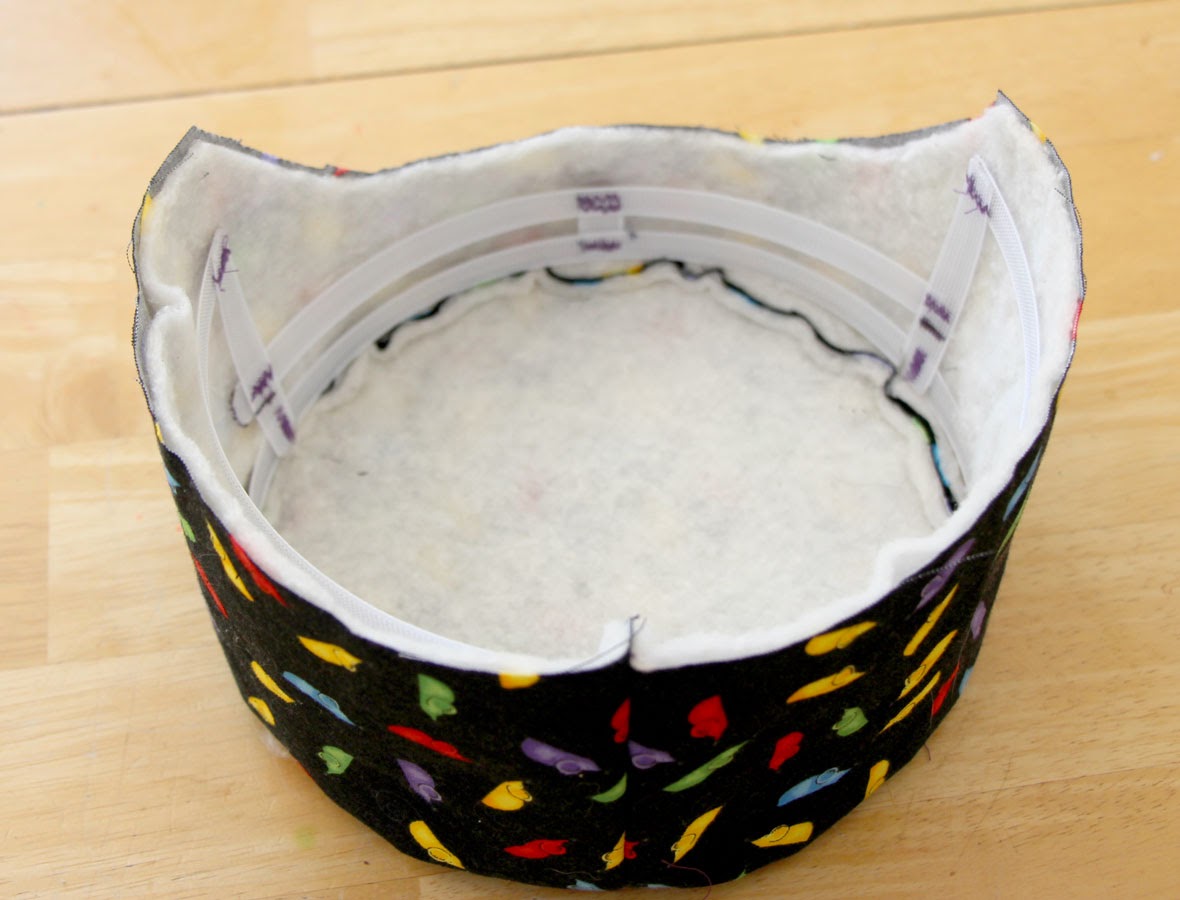
And finally, I made a cuddle cup with a Rigilene frame to keep it from collapsing. Bela is really a fan of the cuddle cup, especially when it doesn't end up squished and flattened in the cage. I made the cuddle cup as described in the tutorial, but built a Rigilene frame like the one shown to the left, and sized it to fit perfectly inside the cup before sewing the cotton/batting cup (outside) to the fleece cup (inside lining), ensuring enough fabric is left above the frame for the seam connecting the cotton to the fleece. Once sized, the frame is removed from the cuddle cup and the cotton/batting cup is sewn to the fleece cup as described in the tutorial, only making the opening through which the cuddle cup will be turned right-side out about 3 1/2" wide. After turning the cuddle cup right side out through the opening, I inserted the frame (it is flexible) inside the cup through the opening, then slip stitched the opening closed once everything was positioned correctly. The only problem I have with this cuddle cup is the top stitching. For some reason, I can never top stitch this item neatly when the Rigilene is in place.


 I couldn't resist the opportunity to create a Peek-a-boo hammock with a rat-shaped opening. I added a zig-zag stitched spiral tail to complement the spiral tails on the fabric.

The following is the DCN decked out in the mouse/rat themed hammocks. I am in the process of making some for Casper as well.


Friday, May 23, 2014

Who's a Cancer Rat? I Don't See Any Cancer Rats!


Casper has been on steroids for a week now. I am not sure whether it has had any effect on the tumor, but it has definitely helped his appetite. He still is not eating dry solid food, but he is eating more of the softer foods. He takes yogurt with strawberry Ensure very well, so that is helping him get his nutrients. He is also eating quite a bit of turkey and sweet potato baby food. He accepts scrambled eggs, hard boiled egg - particularly the yolk, and even an eggfood I make for my birds, consisting of finely grated hardboiled egg, breadcrumbs, and finely grated carrot. He will also have a bit of oatmeal. And he will occasionally pick from other foods (broccoli, banana, grapes, sunflower seeds, lettuce) - the other day, he swiped a piece of Cinnamon Toast Crunch from my son and ate the whole thing. Okay, Cinnamon Toast Crunch isn't high on my list of rat treats, but when you have been diagnosed with a massive lung tumor and your time here is short, you can have a piece of Cinnamon Toast Crunch if that is what you want. Anyway, he is broadening his dietary horizons and is eating more of the things he was eating before.

I weighed him last night and he had gained 20 grams over what he weighed at the vet a week ago, so it is not just my imagination. And to be putting on weight instead of losing it is a really good sign. I always fear with advanced illness like this that malnutrition from poor appetite is likely to do a rat in before the illness itself. So it is really good to see him eating better and putting on weight.

Casper was looking really good Thursday morning, so I took him out for some photos, hoping to get something I can use for a Memorial Day picture. Wow, does the camera love him! He looks so good that I don't see any hint of Cancer Rat in him! It is so wonderful to see him looking so good, I wanted to share some of his photos.


NOTE: Since these photos were intended to get a good Memorial Day picture, I originally wanted to use a pot of red and white geraniums, which would have been more patriotic looking. However, after researching geraniums on the poisonous plants list, I found them listed, so I switched to a pot of yellow pansies instead. Not as patriotic as the geraniums, but non-toxic and safe for our ratties. This is just a reminder to always check the poisonous plants list before exposing your ratties to live plants for photos or play.


Thursday, May 22, 2014

Even Wild Rats Love Dollar Stores!

Article: Inspector: 'When lights went out, party began' with rats at Family Dollar

Okay, I normally ignore the stories in my Yahoo! News Alerts regarding rat infestations, but I just couldn't help sharing this one. Our domesticated rats have known for years that dollar stores are the place to go for the best rat toys at the lowest prices. It seems the news has finally spread to their wild cousins and they just can't get enough!

Wednesday, May 21, 2014

Wheel Running Isn't Neurotic: Wild Animals Love a Good Wheel Too!


Article: Study Shows That Mice Run for Fun not Just for Lab Work

Scientists have sometimes pondered that running in a wheel may actually be a neurotic behavior induced by being cooped up in a cage too long. Of course, most of us with wheel runners know that our pets are not neurotic and that many actually enjoy a good run in the wheel (many big boys, however, prefer a nice long snooze in the wheel to an actual run).

Now, a couple of scientists have gone the extra mile to see whether wild animals, if given the opportunity, would choose to run in a wheel. The answer was an overwhelming "Yes!" They set up a wheel in an outdoor garden area, then set up some cameras with motion detectors to record what happened. The found that wild mice just loved the wheel. And while mice were the most common visitor, they also had rats, moles, frogs, and even snails and slugs work the wheel at least one revolution around.

The article included a brief video of a mouse in the wheel, but I did a little digging and found another video including more mice, a frog, a slug, and a snail: Wild Animals Caught on Hamster Wheel. Worth watching if you don't mind putting up with the 30-second ad that airs before it plays.

I don't know about you, but I suddenly have an irresistible urge to setup a wheel along the back fence of our backyard, hook up a webcam, and see what happens.

Sunday, May 18, 2014

Twice in One Week: Bela Diagnosed with a Lung Tumor


On Friday, Bela went in for her second recheck for a respiratory infection. I had caught it early and brought her in three weeks ago at the first sign. We treated her aggressively with Baytril and Doxycycline. At her one week recheck, she was much improved. The second week of treatment, she was fine. The third week, her symptoms returned - this time, worse and persistent, despite still taking the antibiotics.

After listening to her lungs, the vet decided an x-ray was necessary. When she returned with Bela, she had bad news for me. For the second time in one week, I had brought in a rat for a respiratory infection, only to find out we were dealing with a lung tumor.

You can imagine how surprised and heartbroken I was to get this very same diagnosis, not once, but twice in just a three day period. Bela's tumor is less advanced than Casper's and she likely has more time, since it was caught earlier. We are treating with a steroid (Prednisolone), plus doxycycline to prevent secondary infections, since the steroid weakens the immune system. We also decided to try the same for Casper, although his tumor is more advanced and the steroid is something of a Hail Mary pass.

How Common Are Lung Tumors? Should We Do More X-Rays?

The shock of having two lung tumors diagnosed in one week got me thinking. I had always thought this was not a very common problem. I knew it could happen, but it is not the first thing I would suspect when a rat comes down with respiratory symptoms. I have now had three rats diagnosed with this problem - each time it was caught on an x-ray. It makes me wonder how often this is missed because no x-ray was performed. It made me wonder about Mystery, who passed from chronic respiratory problems. After a while the meds didn't help. Had we done an x-ray, would we have found a tumor there, as well?

My experience is making me wonder if we shouldn't do x-rays more often. Not for those initial mild symptoms that are treated effectively without much fuss. But maybe for those rats who have frequent recurring respiratory symptoms. Maybe for those who stop responding to the antibiotics. Maybe, before we go to all the stops with various meds and trying this and that, we should do an x-ray.

Bela's initial diagnosis of respiratory infection was, in fact, correct. However, the respiratory infection had occurred secondary to the tumor. When given meds, the respiratory infection cleared up rather quickly, but because it was just a secondary problem, the root cause being the tumor, the symptoms returned and the meds were powerless to help.

X-rays always make me cringe because I know they come with a cost. But with Bela, I am thankful that we did it early. Catching a tumor at this stage has saved me several recheck visits, along with more antibiotics and higher dosages of those meds. Doing the x-ray early actually saved me quite a bit of money, and early diagnosis means there is a chance that the steroids will stall the tumor growth and we will get more time. I also am prepared for what will inevitably be coming.

Don't Skip the Vet

This diagnosis is a reminder of why it is in our rats' best interest to NOT throw antibiotics willy nilly at every wheezy rat, but instead, to see a vet when they become ill. I know there is a whole community of rat lovers who will treat respiratory infections at home without the guidance of a vet. I know there are ways to get prescription medications illegally online or to use medications meant for a different species in an off-label way, or to just save leftover medications to try to treat yourself. I choose not to go this route. Everyone must make up their own mind, but these are some of my reasons, and if they influence others, that is great, and if not, at least you go into it aware of what is at stake.

Risks to You and Your Rat
 
Home treatment without the guidance of a vet carries risks. You are at risk of using meds that have expired, that are unsafe, or even not what is advertised. You are at risk of making an error in the dosage calculations. Some medications are safe for some rats but not for others. For example, Baytril is unsafe for rats under 4 months old because it can cause cartilage problems. Vets are better educated in these special cases. Most of all, you are at risk of treating for the wrong thing or with the wrong medication. While you are doing that, your rat is getting sicker; his prognosis, worse. When you finally do see a vet, it will cost you more money and will be harder to treat. We always assume that respiratory symptoms are caused by respiratory infections. But as I have seen, that is not always the case, and even when it is, respiratory infections are opportunistic infections that often crop up secondary to another health problem. For example, Pirate developed a respiratory infection secondary to salmonella poisoning. Treating the secondary problem doesn't do much good if you don't treat the source. Treating yourself and getting something wrong is a waste of money that will only lead to spending more money down the road, risking the health of your rat as the actual problem goes untreated for longer.

Antibiotic Resistance

The other thing to keep in mind is that rampant consumer use of antibiotics without the guidance of a vet leads to antibiotic resistance down the road. I have seen this already happen in the bird world, where many antibiotics are legally available for consumer use. Many of the broad-spectrum antibiotics carried by pet bird suppliers now have absolutely no effect on anything. They have been overused and misused by too many people over too long a period, and everything out there is resistant to them.

To replace these now useless antibiotics, pet bird supply vendors are starting to carry more potent antibiotics, and one of those is Baytril (intended for use in chickens, but sold by pigeon supply stores, and now pet bird suppliers, and marketed to pet birds). This concerns me. When consumers use antibiotics, there is inevitably a large portion of the public who use them incorrectly. They will use them for the wrong thing. They will use the wrong dosage. They will use it for the wrong period of time - stopping after symptoms resolve or stopping when it doesn't seem to be working. They will use it too often, when not even needed. It is not uncommon for a rat to be a little sneezy just because of environment (allergies, new home sneezes, dusty bedding). The more available antibiotics are to consumers, the more consumers will throw an antibiotic at every little dry sneeze. They will use it preventively or as a quarantine measure. You may not be that person, but you can bet than there are many out there who are, and they spoil it for everyone. The bird community has proven it to be true. It would be nice if everyone was as knowledgeable as a vet with regard to diagnosis, dosages, and proper use. Unfortunately, even when we have mastered the latter two, the first will always be trumped by an experienced vet, and many, many people will get all three wrong.

The Emergency Vet Fund

I know it happens sometimes where people end up in tight situations where they just cannot afford a vet, and then they feel they have to resort to home treatment. I never have any advice for this situation. The truth is, if you are truly in that spot (no money to be had anywhere, no credit, nothing to sell, no way to earn money, no one to borrow from), it is too late. It does no good at that point to say, "Well, you should have done XYZ" because we can't go back in time and fix it now. Instead, I offer advice for everyone not in that situation today, with the hope that there will be fewer people in that position tomorrow: Start an emergency vet fund now, even if you don't have rats yet - in fact, that is when you should start the fund - before you have rats. Fund it generously. Never borrow from that fund . . . ever! Remember it is an EMERGENCY vet fund - don't use it if you don't have to - pay your vet bills from your regular budget if that is an option. Replenish that fund in a timely manner before it is needed again. Apply for Care Credit if there is a chance you ever might need it, so that you can finance a vet appointment now and pay it off gradually should the need arise. The only good solution for this problem is to take steps now to make sure you never have that problem. It is like the movie War Games: The only way to win is not to play. Unfortunately, if you don't take those steps before they are needed, it is too late once you end up there.

Thursday, May 15, 2014

Casper Has a Mass in his Lungs


Casper had his vet appointment yesterday, and unfortunately, we received some bad news. The vet listened to his lungs and thought something was not right. She did an X-ray and we learned that Casper has a large tumor in his lungs. The mass is so large that his intestines have been pushed to one side, and she believes it is starting to spread to other organs.

This is heartbreaking news for us, even though he has only been with us for a few days. He is such a sweet boy that we instantly fell in love with him and none of us want this for him. It is so sad that rats are prone to these kinds of problems. Casper really deserves better than this diagnosis. But there is nothing that anyone could have done.

He probably doesn't have much time, but the good news is that so far, he is not suffering and not in pain. He still is lively and alert and inquisitive and enjoys play time a lot. But it explains his labored breathing and his lack of appetite. He has been taken off the antibiotics since he did not have a respiratory infection after all and the meds won't help with the tumor.

The recommendation for Casper is palliative care:
  1. Keep him stress free. Unfortunately, this means he will remain a lone rat as introductions would be too stressful and the other rats may sense the cancer and reject him. 
  2. Spoil him rotten and give him yummy soft foods - anything that he will eat. While he has not been eating his block, he will accept yogurt, oatmeal, baby food, and some people food like chicken, mashed potatoes, bananas, pasta, etc. He has also started sampling from the cereal/seed mix I gave him. 
  3. Give him lots of attention and out time, but also plenty of time to rest so that he doesn't over-exert himself. We will be giving him lots of love, attention, and good foods.

This is a good reminder for us all that not all respiratory problems are respiratory infections and that we should be aware of other potential causes for respiratory symptoms. This is our second rat to have a mass in the lungs - Pirate passed away from this same problem last year.